
Instructions: Click on the '▶' to expand and collapse the paragraphs.
1. Very Short Intro — Saved Alone
In 1873, a woman sent her husband a telegram containing two words that would change his life forever:
SAVED ALONE.
Those two words brought both extraordinary relief and unimaginable heartbreak.
The tragedy that produced them is closely connected with one of Christianity's best-loved hymns, It Is Well with My Soul.
But those two words also present us with a confronting question about eternity.
What if, on the day we meet Jesus, we discover that we have been saved — but some of those we love are not there?
2. Vision Casting — The Story Behind Saved Alone
The True Story
Horatio Gates Spafford was a successful lawyer, businessman and committed Christian living in Chicago, Illinois, during the nineteenth century.
He and his wife, Anna, had four young daughters:
- Annie — approximately 11 years old.
- Maggie (Margaret) — approximately 9 years old.
- Bessie (Elizabeth) — approximately 5 years old.
- Tanetta — approximately 2 years old.
In 1871, the Great Chicago Fire devastated much of the city and caused Horatio significant financial losses.
Two years later, in November 1873, the Spafford family planned a journey to Europe. They hoped to spend time resting and visiting friends, including people associated with the Christian evangelist Dwight L. Moody.
At the last moment, business matters prevented Horatio from travelling with his family.
Rather than cancel the journey, he arranged for Anna and their four daughters to sail ahead. He intended to follow them across the Atlantic.
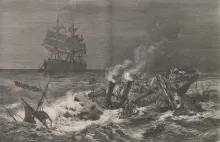
Anna and the girls boarded the French ocean liner SS Ville du Havre, which departed New York on 15 November 1873.
During the early hours of 22 November, while crossing the Atlantic Ocean, disaster struck.
The Ville du Havre collided with the British sailing ship Loch Earn.
The collision tore open the passenger liner. Water poured into the vessel, and within approximately twelve minutes the great ship sank beneath the waves.
Passengers desperately attempted to escape. Lifeboats were difficult to launch, and many people were swept into the freezing Atlantic waters.
Anna struggled to keep her daughters together.
But in the chaos of the sinking ship, she was separated from them.
All four daughters drowned.
Anna herself was swept into the sea. She survived after being found floating on wreckage and was rescued by sailors from the other vessel.
The survivors were eventually transferred to another ship, the Trimountain, which carried them to Cardiff, Wales.
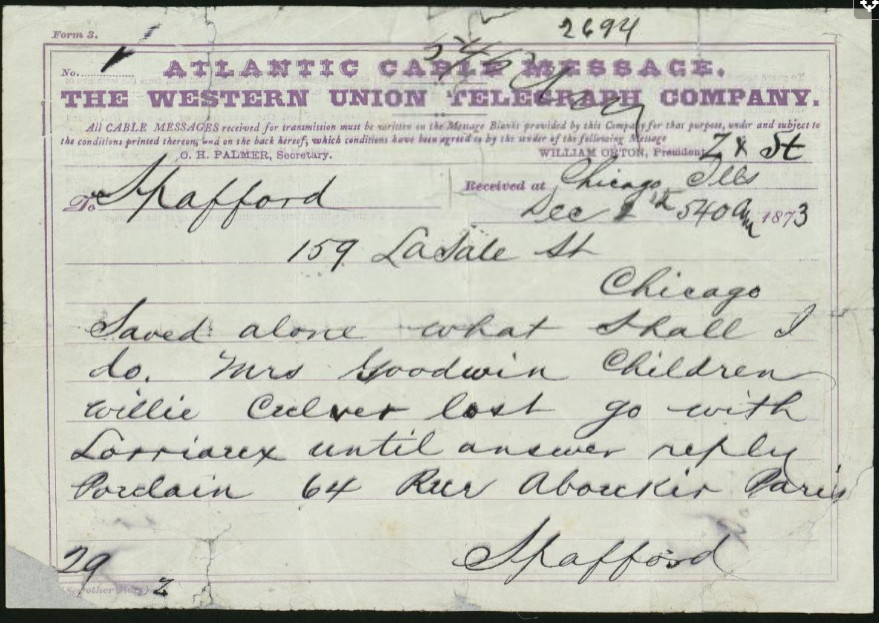
When Anna reached safety, she sent a telegram to her husband in Chicago.
On 2 December 1873, Horatio received the terrible message.
"Saved alone what shall I do."
These were the opening words of a longer telegram reporting the loss of their daughters and other travelling companions.
The original telegram still survives in the Library of Congress in Washington, DC.
A Father's Journey
Imagine Horatio receiving that telegram.
His wife was alive!
But his four beautiful daughters were dead.
Horatio immediately arranged to cross the Atlantic to join his grieving wife.
During the voyage, the captain of his ship informed him that they were passing over the approximate location where the Ville du Havre had sunk.
Far beneath those waters lay the wreck of the ship that had carried his family.
It was also the place where he had lost his four daughters.
In a letter written during that journey, Horatio expressed his belief that his daughters were now safe in God's care.
The tragedy became closely associated with the words of the hymn he wrote:
It is well, it is well with my soul.
The familiar account places the writing of the hymn during his crossing of the Atlantic, near the site of the tragedy. Historical accounts differ about the exact time and place of its composition, but there is no doubt that the hymn arose from the Spafford family's suffering and faith.
In 1876, the Christian musician Philip Paul Bliss composed the music for Horatio's words.
He named the tune VILLE DU HAVRE, after the ship that had carried the Spafford children to their deaths.
That same year, the hymn was published in Gospel Hymns No. 2.
For more than 150 years, Christians have sung these words in times of both joy and sorrow.
Two Words — Saved Alone
Now consider those two words in Anna's telegram.
SAVED.
What an extraordinary relief that word must have brought Horatio!
His wife was alive.
She had survived one of the worst experiences imaginable.
He would see her again. He could hold her in his arms. They could comfort one another and face the future together.
What joy! What relief! What an overwhelming reason for thanksgiving!
But then came the second word.
ALONE.
What crushing heartbreak must have accompanied that word!
Anna was alive, but their four daughters were gone.
No more childish laughter.
No more little arms around his neck.
No more watching them grow into young women.
No more family gatherings with all four girls.
Every hope and dream associated with their daughters' earthly lives had been shattered.
All contained in two words.
SAVED — what extraordinary joy.
ALONE — what unimaginable sorrow.
Now Consider Eternity
One day, every one of us will stand before God.
For those who have trusted Jesus Christ and received his forgiveness, what an extraordinary day that will be!
Our sins forgiven.
Our guilt removed.
Our salvation complete.
Death defeated.
Eternity with our Lord and Saviour!
What joy! What celebration! What overwhelming gratitude!
But now imagine something else.
Imagine discovering that some of the people you loved most during your earthly life are not there.
Perhaps family members.
Perhaps close friends.
Perhaps people you worked alongside for decades.
Perhaps neighbours you greeted almost every day.
People you knew.
People you loved.
People with whom you shared much of your life.
But people with whom you never shared the good news of Jesus.
We do not know the eternal destiny of every person around us. That judgement belongs to God alone.
Nevertheless, Scripture makes clear that the Gospel must be proclaimed and that Jesus has entrusted this responsibility to his disciples.
Could there be something terribly confronting about arriving in eternity and having to consider those two words?
SAVED ALONE.
We cannot save another person. Only Jesus can do that.
But we can pray.
We can love.
We can share the Gospel.
We can invite people to discover Jesus for themselves.
And we can help those who respond become disciples who make more disciples.
(Matthew 28:18–20; Romans 10:13–15; 2 Corinthians 5:18–20)
The Vision-Casting Questions
Consider these two questions carefully.
1. How will you feel on that day?
2. How do you want to feel on that day?
Do you want merely to rejoice in your own salvation?
Or do you want to rejoice as you discover how God used your obedience to help others come to know and follow Jesus?
Imagine meeting people in eternity whose lives were changed because someone loved them enough to share the Gospel.
Imagine discovering that those people had helped others follow Jesus, who in turn had helped still more people.
Imagine generations of disciples gathered before the throne of God.
Not because we saved them.
But because God graciously allowed ordinary people like us to participate in his extraordinary mission.
This is why we make disciples who make disciples.
(Matthew 28:18–20; Revelation 7:9–10)
Group Vision-Casting Activity
Facilitator: Having told the story, do not immediately begin another teaching point.
Allow the weight of the account and its application to settle.
Then say:
"Turn to someone sitting next to you.
Talk together about what moved you most in this story.
What did you feel when you heard those two words, 'Saved alone'?
And what do those words make you think about when you consider eternity?"
Give people time to talk.
Allow the conversations to continue naturally. Do not hurry people or interrupt them with further instructions.
Facilitator — quietly:
After allowing sufficient time for discussion, begin softly singing the hymn It Is Well with My Soul, without musical accompaniment.
Begin singing while the conversations are still taking place.
Do not make a formal announcement.
Simply allow the words of the hymn to be heard gently in the background.
As people hear the singing, allow the conversations to come naturally to a close.
Others may begin singing with you.
There is no need to rush.
Allow space for reflection, silence, prayer and worship.
The words of the hymn are available in the final accordion below.
3. Following — Living with Eternity in View
What Does Jesus Ask of His Followers?
Jesus did not merely call us to receive forgiveness.
He called us to follow him.
And he promised to make his followers fishers of people.
(Mark 1:17)
Following Jesus means learning to see people as he sees them.
People are not interruptions to our comfortable lives.
They are people whom God loves and for whom Christ died.
Discover Together
Read: 2 Corinthians 5:14–21.
Consider the following questions:
- SAY: What does this passage reveal about God and his purpose?
- SAY: What responsibility has Christ entrusted to those who follow him?
- OBEY: What needs to change in the way I see the people around me?
- OBEY: What specific action will I take in response to what I have discovered?
- SHARE: Who needs to hear what I have discovered, and when will I share it?
A Question of Obedience
We cannot determine another person's eternal destiny.
We cannot force a response to the Gospel.
But neither should we use those truths as excuses for silence.
Jesus has commanded us to go and make disciples.
The question is not whether we can save people.
The question is whether we will obey the One who can.
(Matthew 28:18–20; 1 Corinthians 3:6–7)
4. Fishing — Who Will You Tell?
Think of the People God Has Placed Around You
Think about your family.
Think about your friends.
Think about your neighbours and workmates.
Think about the people you see regularly.
Who among them does not yet know and follow Jesus?
Who might be open to hearing his story?
Who could you invite to discover what the Bible says?
A Simple Challenge
Before leaving this gathering:
- PRAY: Ask God to bring to mind someone who needs to hear the Gospel.
- NAME: Identify one person or household you could approach.
- CONNECT: Spend time with them and show genuine interest in their lives.
- SHARE: Tell them something of what Jesus has done for you.
- INVITE: Ask whether they would like to discover a story about Jesus together.
- FOLLOW THROUGH: If they respond positively, help them begin discovering and obeying Jesus.
- REVIEW: Tell your discipleship partner what you did when you next meet.
Remember that we are responsible for obedience, not for manufacturing results.
We plant.
We water.
God gives the growth.
(1 Corinthians 3:6–7)
One Final Question
When you stand before Jesus, whose life do you hope will have been changed because you obeyed his command to make disciples?
Who will you pray for today?
Who will you speak to this week?
Who will you invite to discover Jesus?
Do not leave it as a good intention. Make a plan and act on it.
5. It Is Well with My Soul — Hymn and Historical Sources
It Is Well with My Soul
Words: Horatio Gates Spafford
Music: Philip Paul Bliss, 1876
Tune: VILLE DU HAVRE
First published: Gospel Hymns No. 2, 1876
The original nineteenth-century hymn is in the public domain. The familiar four-verse version can be read at the following link:
Read the complete hymn lyrics — It Is Well with My Soul
Its recurring refrain is:
It is well, it is well with my soul.
Historical Sources
1. Library of Congress — The Original Telegram
The original telegram from Anna Spafford to Horatio is preserved in the American Colony in Jerusalem Collection.
View Anna Spafford's original telegram
2. Library of Congress — Saved Alone
A historical account of the sinking of the Ville du Havre and the loss of the Spafford children.
Read the Library of Congress historical account
3. Hymnology Archive — The History of the Hymn
Detailed historical research into the shipwreck, the development of the hymn, and its publication in 1876.
Read the Hymnology Archive research
Historical accuracy note: The collision, the deaths of the four daughters, Anna's telegram, Horatio's subsequent Atlantic crossing and the hymn itself are well documented. The precise time and location at which Horatio wrote the hymn remain disputed. No reliable evidence establishes that his ship stopped at the sinking location.
Remember: The words "Saved alone" referred to Anna's survival of a shipwreck. They make a powerful illustration for Christian vision casting, but they do not establish the eternal destiny of her daughters.
Explore related areas: Vision Casting | Following | Fishing
Comments